


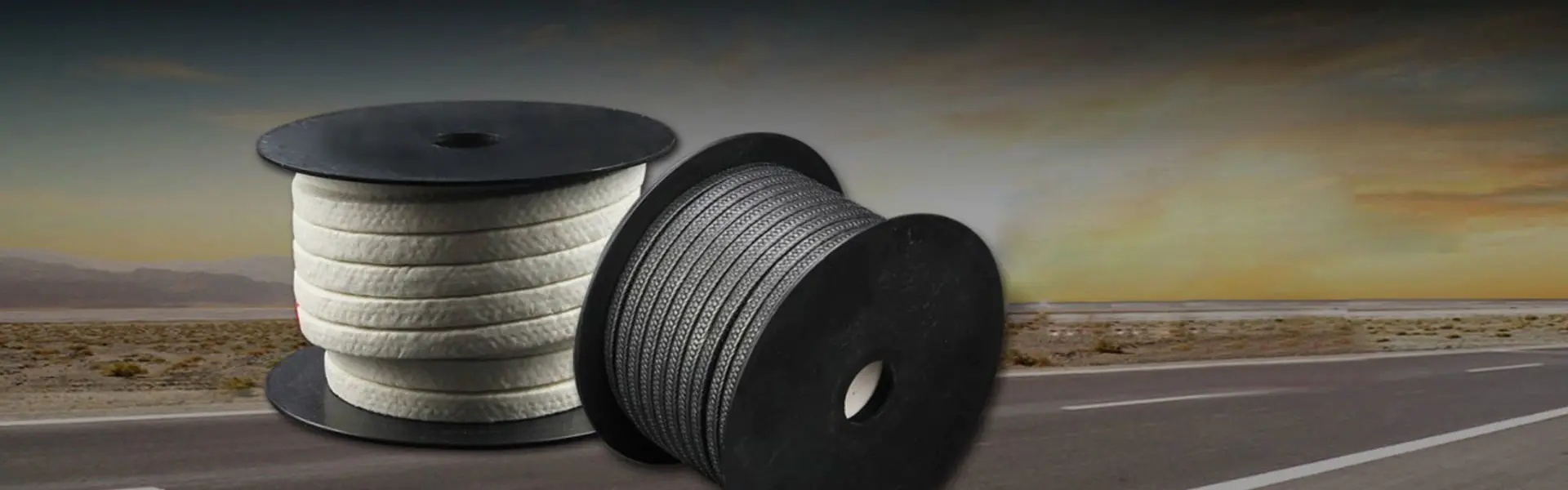
A maintenance engineer walks a pipe rack at two in the morning and spots a thin, chalky trail running down a DN200 flange. Eleven months ago that joint was dry, torqued to 65 N·m and signed off. Now the line is scheduled for shutdown in six hours, and the spare gasket on the shelf is the wrong thickness. Anyone who has stood in that position has asked the same question: What Causes Expanded PTFE Gasket Failure and How Can You Prevent It? In most plants the answer is not one dramatic defect. It is a chain of small decisions — a torque value nobody re-checked, a flange face with a deep radial groove, a gasket compressed too hard at installation, a thermal cycle nobody modelled, or a cheap sheet sold as expanded PTFE that was really a filled skived film. Expanded PTFE is one of the most forgiving sealing materials available, which is exactly why failures are so often blamed on the gasket when the joint, the bolts or the storage shelf is the real culprit. This guide walks through the five failure modes behind the overwhelming majority of ePTFE leaks, gives the measurable parameters that predict them, and shows where Ningbo Kaxite Sealing Materials Co., Ltd. fits into a procurement and maintenance strategy that stops the leak before the flange is opened.

The scene. A DN200 stainless line carrying 30% caustic at 120 °C is torqued to 65 N·m on a Monday morning. On the first heat-up the joint is dry. Eight weeks later a thin caustic crust appears at the bottom of the flange. Nothing has changed except time — the bolts are still there, the flange has not moved and nobody has touched the gasket, yet the compressive stress that keeps the joint sealed has quietly drained away. This is creep relaxation, and it is the single most common reason expanded PTFE gaskets fail in service.
Why it happens. Under sustained bolt load and elevated temperature, the fibrillated structure of expanded PTFE slowly densifies. The gasket gets thinner, the bolts relax, and the remaining seating stress falls below the level needed to close the micro-finish of the flange face. Wide flanges, thick gaskets, over-torqued bolts and high operating temperatures all speed the process up.
The solution. Control the stress history of the joint from the first torque onwards: specify the correct gasket density and thickness, use calibrated torque with lubricated fasteners, fit disc springs where thermal movement is expected, and schedule a hot re-torque after the first full thermal cycle. Suppliers such as Ningbo Kaxite Sealing Materials Co., Ltd. can recommend density and thickness combinations for a specific flange class, which removes much of the guesswork for the maintenance planner.
| Joint parameter | Target value | Why it matters |
|---|---|---|
| Gasket seating stress | 20–35 MPa | Below roughly 15 MPa, ePTFE cannot flow into the flange micro-finish and seal |
| Gasket thickness | 1.5–3.0 mm | Thinner gaskets relax less; thicker gaskets recover better on slightly warped flanges |
| Torque scatter | Within ±10% across the bolt set | One soft bolt unloads its neighbours and opens a leak path |
| Continuous service temperature | Up to 260 °C | Above this, PTFE decomposes and creep accelerates sharply |
| Hot re-torque | After the first thermal cycle | Recovers 15–30% of the bolt load lost during initial heat-up |
The scene. A chlorine transfer line has been leaking at the flange for three shutdowns in a row. The gasket surface looks intact, but the studs are rusted and the flange face is pitted. The failure is not on the inside of the joint — it is on the outside. PTFE resists an enormous range of chemicals, but it is not impermeable, and aggressive media can migrate through the gasket matrix, attack the fasteners and eventually undermine the whole connection.
Why it happens. Permeation through expanded PTFE depends on the medium, the temperature, the pressure and the density of the material. Higher density reduces permeation but increases creep; lower density seals better on rough flanges but passes more vapour. Add strong oxidisers or molten alkali metals and the polymer itself starts to degrade. Gas service, hot solvents and vacuum lines are all high-risk applications that are frequently specified with a standard ePTFE sheet and no engineering review.
The solution. Match the grade to the medium, not just to the pipe size. For permeating gases, specify a denser ePTFE or a barrier layer and consider a gasket with encapsulated or coated stainless studs. For oxidisers, review whether PTFE is the right material at all. Kaxite's technical team routinely reviews media lists and operating temperatures before quoting, and can propose filled or layered constructions when a plain ePTFE sheet is the wrong answer.
| Service medium | Typical limit for ePTFE | Practical note |
|---|---|---|
| Mineral acids and alkalis, 10–50% | Up to 260 °C | Standard unfilled ePTFE performs well; check concentration and aeration |
| Wet chlorine, bromine and other halogens | Ambient to moderate | Permeation can reach the bolts and cause stress corrosion cracking |
| Fuming nitric or fuming sulphuric acid | Not recommended | Oxidising attack plus rapid permeation; use a barrier seal or a different design |
| Molten alkali metals, elemental fluorine | Not recommended | PTFE reacts violently; specify graphite or metal seals instead |
| Food, potable water and pharmaceutical fluids | Up to 260 °C | Request FDA, EU 1935/2004 and WRAS documentation with the delivery |
The scene. The gasket arrives correctly, the flange is spotless, and the joint still leaks on start-up. Somewhere between the warehouse and the bolt-up, the gasket was stored on its edge, dragged across a dirty flange face, tightened in a circle instead of a star, or compressed with an impact wrench set to the highest setting. Expanded PTFE is soft and easily bruised, and installation damage is the failure mode that leaves the fewest clues behind.
Why it happens. Torque wrenches go uncalibrated, bolts get re-used without inspection, flange faces get cleaned with a grinder instead of a wire brush, and nobody checks flatness after a hot job. The gasket may be crushed past its recovery limit, pinched into a spiral-serrated groove, or simply compressed unevenly, so one side of the joint carries almost no load.
The solution. Treat installation as an engineering step. Train fitters on cross-pattern tightening, keep a calibrated wrench on the job, inspect flange faces with a straight edge and a feeler gauge, and store gaskets flat in a cool, dark place. Kaxite supplies cut gaskets with clear size and grade markings on the packaging, which makes it far harder to fit the wrong sheet and far easier to record which batch went into which joint.
| Installation check | Acceptance value | Failure it prevents |
|---|---|---|
| Flange face roughness | Ra 3.2–6.3 µm, concentric grooves | Poor micro-seating and cut-through on serrated faces |
| Flatness and parallelism | No visible warp; gap checked with a feeler gauge | Uneven stress and local extrusion |
| Bolts and nuts | Clean, lubricated, new or formally inspected | False torque readings of 20–40% |
| Tightening pattern | Star pattern at 30%, 70% and 100% of final torque | Wrinkled, pinched or unevenly compressed gaskets |
| Storage before use | Flat, dark, below 25 °C, away from ozone sources | Permanent set and surface contamination before installation |
Question 1: Our expanded PTFE gaskets fail on a heat-exchanger line every three to six months, but the same gasket lasts years elsewhere. What causes that?
Answer: A repeatable interval like three to six months almost always points to a thermal or mechanical cycle rather than a chemical incompatibility. The gasket is probably recovering well on day one, then losing bolt load as the flange expands and contracts. Check the heat-up rate, confirm whether the flange pair is actually parallel when hot, and look at the bolts — if the studs are long and slender, they stretch and the joint loses stress. A denser ePTFE grade, disc springs and a documented hot re-torque usually break that cycle. Before changing materials, ask your supplier for a density-controlled ePTFE and compare joint behaviour over two cycles.
Question 2: Can we stop a weeping joint simply by adding another gasket or tightening the bolts harder?
Answer: No, and both shortcuts create a bigger problem. Stacked gaskets double the creep path and are a recognised source of catastrophic blow-out on steam and gas lines. Over-tightening crushes the ePTFE past its recovery limit, which is why many joints that were “nipped up” at the end of their life fail completely within days. The correct response is to isolate the line, open the joint, inspect the flange faces for grooves and corrosion, verify the gasket grade against the medium, and rebuild the joint to a specified torque. If the leak returns after a correct rebuild, the problem is a process condition, not the gasket.
The scene. A batch reactor goes from ambient to 180 °C and back twice a day. After a few hundred cycles the gasket has visibly thinned on one side and started to extrude into the flange gap, leaving a thin lip overhanging the bore. Once that lip forms, the joint will never seal reliably again.
Why it happens. Expanded PTFE flows under load, especially at temperature. Rapid heat-up rates create a large temperature gradient across the flange, the differential expansion squeezes the soft gasket radially outward, and the small gap between the flange faces becomes an escape route. Over-pressure, an oversized bore clearance or the wrong pressure class table all make extrusion worse.
The solution. Slow the heat-up, verify that the gasket pressure rating suits the flange class and the gap at operating conditions, and specify a grade with higher resistance to extrusion where temperatures climb above roughly 150 °C. Kaxite produces ePTFE sheet and cut gaskets in several densities, so a process engineer can trade off conformability against extrusion resistance without changing suppliers or standards.
| Thermal parameter | Recommended practice | Consequence if ignored |
|---|---|---|
| Heat-up and cool-down rate | Below 50–100 K per hour on thick flanges | Differential expansion squeezes the gasket out of the joint |
| Flange gap under pressure | Under 0.2 mm | Gap extrusion and a permanent leak channel |
| Cyclic operating range | Kept within the gasket's proven envelope | Fatigue of the fibrillated PTFE structure and progressive thinning |
| Insulation and tracing | Uniform, with no cold spots | Local condensation, corrosion and one-sided thermal stress |
The scene. Purchasing finds an ePTFE gasket sheet at a third of the usual price, buys a year of stock, and the failure rate doubles across the plant. The sheet was described as expanded PTFE in the catalogue but behaves like skived PTFE: it is dense, stiff, and refuses to conform to the flange finish. Nobody can prove it, because the delivery came with a generic datasheet and no batch record.
Why it happens. Expanded PTFE is defined by its manufacturing process, not by its name. A genuinely fibrillated sheet has a low density and high compressibility; a substituted or heavily filled sheet does not. Buyers who compare only thickness, size and price end up with a material that looks identical in a photograph and behaves completely differently under a bolt.
The solution. Buy on specification and evidence, not on appearance. Request density, compressibility, recovery and tensile data for the actual batch, ask for the material grade to be printed on the label, and qualify a supplier on traceability rather than on the lowest quote. Ningbo Kaxite Sealing Materials Co., Ltd. issues batch-linked test reports with ePTFE sheet and cut gaskets, so the material that reaches the flange can be traced back to a production record — exactly the evidence a procurement team needs when a joint fails and the question of material quality comes up.
| Property | Genuine expanded PTFE gasket | What a substituted sheet looks like |
|---|---|---|
| Density | Approximately 0.6–1.0 g/cm³ | 2.1–2.2 g/cm³, typical of skived or moulded PTFE |
| Compressibility | Roughly 40–60% | Often below 20%, so the gasket never conforms |
| Recovery | High, with visible fibrillation on the cut edge | Low, with a smooth, glassy cut edge |
| Documentation | Batch traceability, density report, certificates | Generic datasheet with no batch reference |
Most ePTFE failures can be prevented before the flange is opened. The checklist below is the sequence Kaxite's sealing engineers recommend to maintenance and procurement teams who want to stop repeating the same repair.
| Step | Action | Owner |
|---|---|---|
| 1 | Match gasket grade to medium, temperature and pressure class | Process engineer |
| 2 | Confirm the flange face finish, flatness and gap at operating temperature | Maintenance planner |
| 3 | Specify density, thickness and torque, and put all three on the work order | Reliability engineer |
| 4 | Buy on batch test data, not on catalogue descriptions | Procurement |
| 5 | Store gaskets flat, clean and away from sunlight and ozone | Stores |
| 6 | Train fitters on star-pattern tightening and calibrated torque | Workshop supervisor |
| 7 | Hot re-torque after the first thermal cycle on high-temperature lines | Operations |
| 8 | Record batch, torque and date for every joint, and review repeats quarterly | Maintenance engineer |
Question 1: How can a buyer tell whether a supplier is really shipping expanded PTFE and not a filled or skived substitute?
Answer: Ask for three things before the first order: a batch-linked density figure, a compressibility and recovery report, and a cut-edge photograph or micrograph showing the fibrillated structure. A genuine ePTFE sheet sits around 0.6–1.0 g/cm³ and compresses by roughly 40–60% under standard test load; a skived PTFE sheet sits above 2 g/cm³ and barely deforms. A supplier who cannot produce batch data is asking you to accept the risk on their behalf. Kaxite provides these records as standard, which is what makes an apples-to-apples comparison possible between quotations.
Question 2: Should we stock full ePTFE sheets and cut in-house, or buy finished gaskets?
Answer: It depends on how many non-standard sizes you carry and how tight your maintenance window is. Full sheets in two or three thicknesses give flexibility for odd flanges and emergency work, while finished cut gaskets remove cutting errors, reduce waste and guarantee that the correct grade is used on each line. Most plants do both: standard sizes as finished gaskets from a qualified supplier, plus a small sheet stock for unplanned jobs. Keeping a single qualified source for both, with the same batch documentation, keeps the specification consistent across the site.
Ningbo Kaxite Sealing Materials Co., Ltd. is a manufacturer of sealing materials based in Ningbo, China, supplying expanded PTFE gaskets, PTFE sheet, filled PTFE and precision cut seals to distributors, OEMs and maintenance teams in chemical processing, pharmaceuticals, food and beverage, and power generation. If your flanges keep leaking, or if you are building an ePTFE specification for a new project, Kaxite can supply density-controlled ePTFE sheet, cut-to-drawing gaskets, batch traceability records and third-party test reports, with responsive technical support and reliable delivery. Visit https://www.kaxite-seal.net to review the product range, or email [email protected] to discuss your operating conditions with their sealing engineers.
Sawa, T., Higurashi, N., & Akagawa, H. (2010). Variation in gasket stress and sealing performance in bolted flange joints under pressurisation. Journal of Pressure Vessel Technology, 132(3), 031202.
Abid, M., & Nash, D. H. (2009). A parametric study of metal-to-metal contact flanges with gaskets. International Journal of Pressure Vessels and Piping, 86(1), 63–69.
Flitney, R. K. (2007). Seals and Sealing Handbook (5th ed.). Elsevier, Oxford.
Ebnesajjad, S. (2016). Expanded PTFE Applications Handbook: Technology, Manufacturing and Applications. William Andrew Publishing, Norwich.
Müller, H. K., & Nau, B. S. (1998). Fluid Sealing Technology: Principles and Applications. Marcel Dekker, New York.
Nechache, A., & Bouzid, A.-H. (2007). Creep analysis of bolted flange joints and its effect on gasket stress relaxation. Journal of Pressure Vessel Technology, 129(4), 693–699.
Bouzid, A.-H., & Nechache, A. (2005). The effect of gasket material on the tightness of bolted flange joints. Journal of Pressure Vessel Technology, 127(3), 291–298.
Kobayashi, T., & Nishida, T. (2013). Thermal cycling tests and leak evaluation of gasketed joints at elevated temperature. Journal of Pressure Vessel Technology, 135(2), 021201.
Veiga, J. C., & Ferreira, L. C. (2011). Sealing behaviour of expanded PTFE gaskets at high temperature. Materials & Design, 32(6), 3498–3505.
Brown, W., & Delaney, P. (2015). Failure analysis of gaskets in chemical process industry flanged joints. Sealing Technology, 2015(7), 8–12.
-


